
The most economical way to build up your three-month food supply is to shop the sales and Prepared LDS Family has come up with a list of food and non-food items that typically go on sale during the month of June, particularly those that are bolded:
Shelf Stable Foods
Bottled water (look for $2.99 or less for 24 ct. case), powdered milk (LDS), dry beans (LDS), dry split peas & lentils, freeze dried vegetables, butter powder, dried fruits & raisins, salad dressing, croutons, lemonade mix, pancake mix, tapioca
Freezer
roasts, strawberries, sausage
Toiletries
contact solution, mouthwash
Paper & Cleaning
laundry stain remover, dish soap
Medical Supplies
vaseline, measuring spoon, assorted band aids
Family Emergency Kit Supplies Part 2
(items you share as a family in a grab and go container)
crescent wrench, duct tape, large flashlight, spare flashlight batteries, hand can opener, mess kits, disposable hand wipes, sunblock, insect repellant
Equipment & Fuel
lumber for food storage shelves, firewood, or cooler
Other items that go on sale in June: Summer clothing (back to school clothes will start filling shelves. So take advantage of summer clearances. My favorite time to shop!), dresses, summer sports gear, men's clothing (Father's day is a great time to shop for Christmas gifts too!), refrigerators, TV's, computers, electronics, fabrics, building materials, pianos, canning supplies
Monday, June 7, 2010

Friday, June 4, 2010
Another good reason why an emergency water supply should be your first priority
Who doesn't take their daily water supply for granted? Thank heavens I don't have to walk a quarter mile to get fresh water for cooking, baking and laundry like my great-grandmother did. Thank heavens my water supply is on-tap and abundant, but we have experienced enough well problems to know that supply can be interrupted without warning.
Below is a post from The Ready Store that re-emphasizes why an emergency water supply should be your first priority:
Turns Out it Can Happen in My Neck of the Woods
About three weeks ago on a Sunday night I laid down in my bed with a book to enjoy the end of the weekend. Unfortunately my stomach was little unsettled and was progressively getting worse. By the next morning I had full blown flu like symptoms.
A day or two later and a couple of my kids had the same symptoms and within two weeks everyone in the house had caught the bug. The day after my wife was finally feeling better we got a knock on the door.
A volunteer from the city was passing out fliers instructing all residents of my subdivision to boil all tap water before drinking. It turns out that somewhere the culinary and irrigation lines had crossed and as a result contamination occurred.
In the end hundreds of people were already sick before the city issued the boiling order. Within hours the local Wal-Mart and Grocery Stores were completely emptied of all bottled water.
It just so happens that also a few weeks ago, almost 2 million residents of Boston also lost their supply of drinking water due to a large pipe bursting and were issued order to boil all water before drinking.
When you read this, there’s two things you should consider…
It can and likely will happen in your neck of the woods. It may not be bacteria in the water or a bursting pipe that prevents you from using your tap water without boiling, but it might be a hurricane, tornado, earthquake, or some other natural or man made disaster. Whether it’s small town Utah or a major metropolis like Boston we’re all prone to disasters regardless of location.
Once disaster strikes, the time to prepare is past. If you’re not ready before disaster strikes you join the masses who scramble at the last second and scrap like a pack of dogs for a bone that’s already been picked clean.
The challenge with some people is just getting started. A slow and steady approach where you consistently add items to your emergency supply over time can place you and your family on firm ground where you have the peace of mind to face disaster head on.
Take the time to assess where you’re at and identify your weak points and then make the commitment to fill the gaps. In my case where we were under a boil order a couple of 5- Gallon Stackables and a MSR SweetWater Purifier System works well to help you ride out the storm.
Tuesday, May 18, 2010
How to turn off your water supply
Okay - maybe turning off your water supply in an emergency is a no-brainer for most of you, but for the rest of us with an underdeveloped left side of the brain - a visual "how-to" is pretty darn helpful. We won't mention the unfortunate broken pipe in the garage after a heavy freeze and thaw cycle and trying to dig through 3 feet of snow to even find the water supply shut-off. Let's just say - hurray for the Good Samaritan neighbor who showed up in the nick of time.
So here it is - another how-to video from one of my favorite blogs by Jodi and Julie at Food Storage Made Easy:
In an emergency situation where your municipal water source could be contaminated, it is important to immediately turn off the water entering your home from the main water line. This will help to prevent contamination and will allow you to use alternate water sources in your home such as: hot water heater, toilet tanks (unless a colored disinfectant was used), water pipes, soft water tanks, etc.
Since we did not know how to shut off the main water supply our homes, we commissioned Jodi’s sweet hubby to help with this instructional video. We all need to know how to do these things since you never know who will be home (or not home) when an emergency strikes!
If you live in a newer home you may have a shut-off valve in your house. This is nice because you can avoid the “spider problem” but can be bad if you have children that are rascals (see Julie’s water adventures story). So figure out what type of shut-off valve you have and make sure you know where it is and how to turn it off (and back on!)
Other helpful “Water” Resources
BabyStep 2: Water – basic information on how to get your 2 week supply of water
Alternate Water Sources – Sources of water both inside and outside your home
How to Make an Evaporation Still – Instructions for this method of collecting water
Water Purification – Methods of purifying water from outside sources
Friday, May 14, 2010
Three months food storage - the before and after views from foodstoragemadeeasy.net
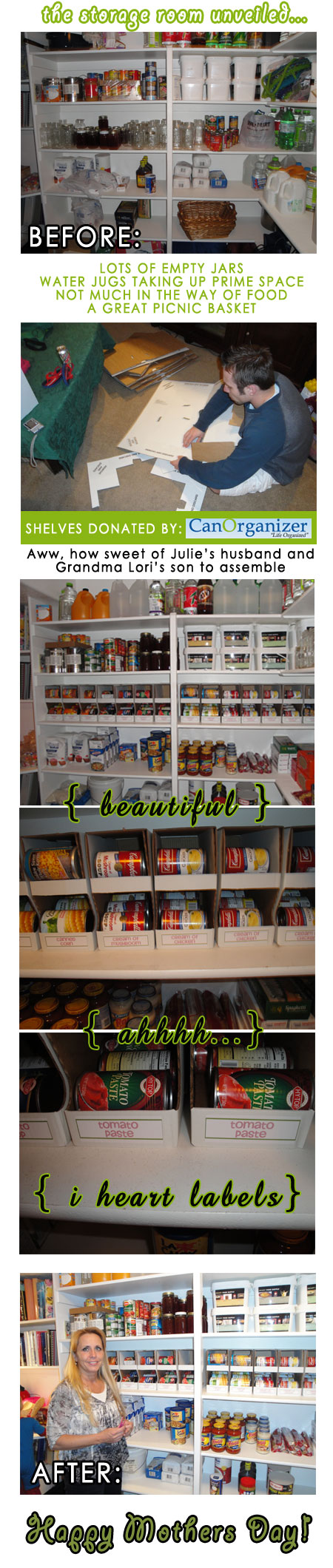
Although you may not have enough extra storage space in your home to dedicate an entire closet to a three month food storage supply - it's helpful (thanks to Jodi and Julie at Food Storage Made Easy) to have a visual of how much room three months of food storage looks like. And it's not nearly as challenging as it may sound. The easy-to-assemble cardboard can organizers make it so much easier!
Tuesday, May 11, 2010
What does 3 months of food storage look like?
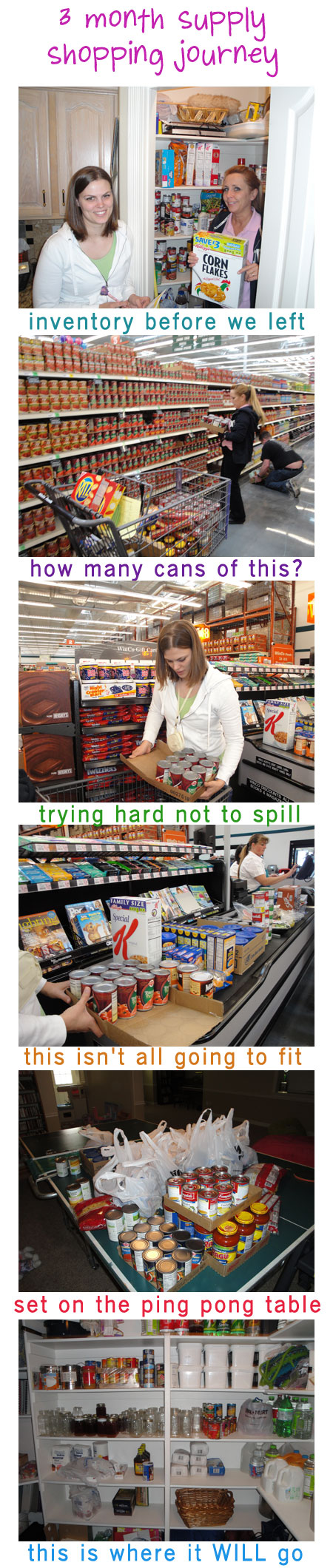
Last post showed what a bare minimum, keep you alive food storage for one looks like. If, however, the reality of living on beans, whole wheat and powdered milk for one year sounds a little overwhelming - Jody and Julie from Food Storage Made Easy just posted what a three-month-eating-what-you-normally-eat food storage looks like. At least the shopping part. Stay tuned for the on-the-shelf view sometime soon.


If you’re following Grandma Lori’s Extreme Food Storage Makeover, you know that last time we left off with a “to be continued” after Julie made Lori her full shopping list based on her recipes she wanted to use in her three month food supply. The post was titled “We have a Plan”
Well last week Julie was running out of ideas for Mother’s Day presents so she called up Grandma Lori and said, lets get this shopping trip done! (Because once the shopping was done, she could do the real present – which is organizing the whole food storage room) Grandma Lori wanted to go ahead and buy all the food up front, then replace through normal use, and sale shopping…. So it made for a big shopping trip to say the least.
Surprisingly however, the shop wasn’t NEARLY as painful as we thought it would be. We took the excel file that had calculated exactly everything she needed and used it as our shopping guide. Before we went to the store, we took inventory of what she already and then we were actually in and out of the store fairly quickly.

If you’re following Grandma Lori’s Extreme Food Storage Makeover, you know that last time we left off with a “to be continued” after Julie made Lori her full shopping list based on her recipes she wanted to use in her three month food supply. The post was titled “We have a Plan”
Well last week Julie was running out of ideas for Mother’s Day presents so she called up Grandma Lori and said, lets get this shopping trip done! (Because once the shopping was done, she could do the real present – which is organizing the whole food storage room) Grandma Lori wanted to go ahead and buy all the food up front, then replace through normal use, and sale shopping…. So it made for a big shopping trip to say the least.
Surprisingly however, the shop wasn’t NEARLY as painful as we thought it would be. We took the excel file that had calculated exactly everything she needed and used it as our shopping guide. Before we went to the store, we took inventory of what she already and then we were actually in and out of the store fairly quickly.
Saturday, May 8, 2010
Bare minimum food supply for one year

Thanks to Erika Grover and Gail Richmond for this visual of what a bare minimum food storage for one person looks like. It's not fancy, but it will keep you alive. Kinda reminds me of Moses leading the children of Israel through the wilderness. I can imagine the kids waking up every morning and saying "What - manna again?" But it sure beats starvation!
EXACTLY WHAT DOES A 1 YEAR FOOD SUPPLY FOR 1 PERSON LOOK LIKE?
These are the MINIMUM Basic Amounts of Food Needed for Survival for ONE PERSON for ONE YEAR:
BARE-MINIMUM LDS Church Food storage requirements for
1 adult male for 1 year Approx. 2,300 calories per day. (only 695lbs total)
Some people try to rationalize that we "really" don't need to store everything that we have been asked to store. The regular excuses of no money, no room, no time, don't know how to use wheat, or don't eat wheat, etc. Some have heard "that is so much to store", that "our family would never use 400 pounds of grains per person in an entire year". Also, "we don't use that much salt or oil", therefore they don't feel they need to store it."
This food can be purchased at a grocery store. It’s not overwhelming when you see it this way, it’s impressive!
With these ingredients pictured (and adding yeast which we know is not on the basic list – but hopefully we have stored), we would be able to make one loaf of bread and 1/3 cup of beans. That would be your food for the entire day. Beans and wheat make a complete protein that will sustain the health of the body.
* Protein is essential for many bodily processes, including building and repairing tissue. You use protein to make enzymes, hormones, and other body chemicals. Plus, your hair and nails are mostly made up of protein. It is an important building block of bones, muscles, cartilage, skin, and blood.
* Foods can be combined to make complete proteins like pairing beans with rice or corn. There are other combinations as well. Beans and seeds, beans and nuts, and beans and grains will form a complete protein. Protein is necessary for building/rebuilding healthy tissue in the body.
DON’T FORGET THE WATER!
· 14 Gallons per person per 2 weeks.
· For long term emergency use, you might want to consider an emergency filtration system (filtering straws, bottles, etc.)
Monday, May 3, 2010
Home Depot Garden Club

Okay - it is May and it's snowing outside, but summer is still coming (even if spring is a little iffy). If you love to garden or wish that you knew how to garden, Pinching Your Pennies (PYP) just posted a link to the Home Depot Garden Club. It offers all kinds of great tips by climate zone and some great gardening coupons if you join.
Get HOT coupons!
Home Depot Garden Club
This is a HOT one! The coupons they send are great.
Join now for FREE and get:
* Exclusive members only coupons and savings delivered right to your inbox.
* Timely regional tips and advice, delivered biweekly.
* Expect answers to your gardening questions within 24 hours.
LINK TO SIGN UP
Here is a sample of the coupons they've sent in the past:
* Buy one Tree, get one FREE (of equal or lesser value)
* $3 off 5M or $6 off 15M TurfBuilder with Summerguard Lawn Fertilizer and Insect Killer
$3 off Cutter Bug Free Backyard Hose End or Concentrate
$1 off 32 quart or $2 off 64 quart or Miracle Gro Moisture Control Potting Mix
* $3 off a Propane Exchange or $4 off any New Tank purchase.
$2 off any Clorox ProResults Outdoor Bleach 32 oz.
$4 off Weed-B-Gon Ready-To-Spray concentrate of any Quart concentrate
Subscribe to:
Posts (Atom)


